






Continuing Professional Development
Your learning with us counts.
As a member of the Institute, much of what you do with us — attending an event, joining a webinar, completing a short course, or engaging with our research — can be counted towards your continuing professional development.

Keeping your knowledge and skills up to date.
Continuing professional development is the way professionals keep their knowledge and skills up to date across their careers. Many professional bodies ask their members to undertake a certain amount of CPD each year and to keep a record of it.
Your time with us, working for your own CPD record.
You can count time spent in focused learning with us, including:
Talks, lectures & events
Attending our talks, lectures and events
Online webinars
Taking part in our online webinars
Short courses
Completing our short courses
Research & resources
Engaging with our research, publications and learning resources
How CPD hours work
As a general rule, one hour of learning equals one CPD hour. A 60-minute webinar counts as one hour; a half-day course of three hours' content counts as three. For self-directed activities, such as reading our research, you simply record a reasonable estimate of the time you spent.
Certificates
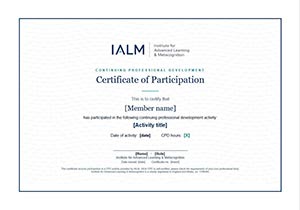
For our structured activities — events, webinars and short courses — we provide a certificate of participation confirming the activity, the date and the number of CPD hours. You can keep these as evidence for your own CPD record.
Recording your CPD is simple.
Keep a note of the activity, the date and the hours, and retain your certificates. You're welcome to use our CPD log to help.
Download our CPD Log →One important note
CPD in the UK is largely self-regulated, and requirements differ from profession to profession. Our CPD is self-certified: our certificates provide the evidence most bodies expect, but we recommend checking your own professional body's rules, as we can't guarantee how another organisation will treat it.
FAQs
Common questions about CPD with IALM.
Click each one to expand — or click again to close.
No. We don't make CPD a formal condition of membership, but we actively encourage it — and we've designed much of what we offer, from events to research, so that it can count towards your professional development. Building CPD into your year is entirely up to you, and we're glad to support you in doing it.
CPD covers any focused learning that helps you keep your knowledge and skills up to date — formal activities like courses and structured training, as well as more informal learning such as reading, self-directed study or learning through experience. With IALM specifically, you can count time spent attending our talks, lectures and events, taking part in our webinars, completing our short courses, and engaging with our research, publications and learning resources.
There's no single right way to approach CPD, and we don't prescribe a fixed format. As a general guide, it helps to think about what you want to develop, choose activities that build towards that — a mix of formal learning, like our courses and events, and more informal learning, like reading or discussion — and take a few minutes afterwards to note what you've gained. Keeping it simple and consistent matters more than following any particular system.
As a general rule, one hour of learning equals one CPD hour. A 60-minute webinar counts as one hour; a half-day course of three hours' content counts as three. For self-directed activities, such as reading our research, you simply record a reasonable estimate of the time you spent.
For our structured activities — events, webinars and short courses — we provide a certificate of participation confirming the activity, the date and the number of CPD hours. You can keep these as evidence for your own CPD record.
Recording your CPD is simple: keep a note of the activity, the date and the hours, and retain your certificates. You're welcome to use our CPD log, available further up this page, to help.
No. IALM doesn't ask members to submit their CPD records to us, and we don't assess or audit them. We provide the learning activities and the certificates; keeping and using the evidence is entirely yours to manage, in whatever way works best for you.
CPD in the UK is largely self-regulated, and requirements differ from profession to profession. Our CPD is self-certified: our certificates provide the evidence most bodies expect, but we'd recommend checking your own professional body's rules, as we can't guarantee how another organisation will treat it.
Many of our talks, webinars and courses are open to non-members too, so you don't necessarily need to be a member to take part. That said, membership gives you full access to our learning programme, discounted member rates and priority booking, making it easier to build CPD into your year — alongside the wider benefits of belonging to the Institute.
Ready to start?
Become a member to make the most of everything that counts towards your CPD, or see what's coming up next.