
Most students, when preparing for a test, concentrate their effort into the days immediately beforehand. It feels like the sensible approach. The exam is close, so that is when the work should happen. Research on memory and forgetting tells a different story, one that has been understood by psychologists for well over a century, yet still rarely shapes how revision is actually organised.
The forgetting curve
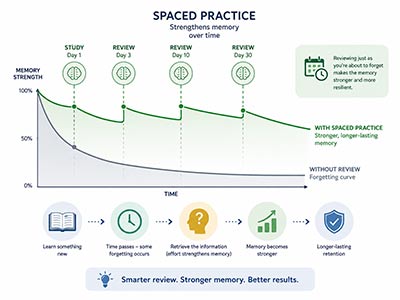
In 1883, the German psychologist Hermann Ebbinghaus conducted a series of careful experiments on his own memory, testing how quickly he forgot lists of nonsense syllables over time. His results produced what is now known as the Forgetting Curve. Memory for new information drops away quickly at first, then more slowly, unless it is reviewed again.
What Ebbinghaus also discovered, and what later researchers confirmed many times over, is that reviewing information just as it is about to be forgotten, rather than while it is still fresh, has a disproportionately strong effect on how well it is retained afterwards. This is the basis of what is now called the Spacing Effect.
Why gaps matter
It seems counterintuitive that letting yourself partly forget something could be better for learning than reviewing it while it still feels fresh. The explanation lies in effort. When information is still easy to recall, reviewing it again requires very little mental work, and that ease translates into a weak boost to memory. When some forgetting has occurred, retrieving the information again requires genuine effort, and that effort is what strengthens the memory trace and makes it more resistant to future forgetting.
This is closely related to the idea of Retrieval Practice. Spacing works best when the review itself involves trying to recall the information, not simply looking at it again. Spaced re-reading is better than massed re-reading, but spaced retrieval is more powerful still.
What this means for revision timetables
The practical implication is straightforward, even though it runs against how most people naturally plan their study time. Rather than concentrating all revision for a topic into a single block shortly before an assessment, spreading the same amount of study time across several sessions, with increasing gaps between them, produces stronger and more durable learning.
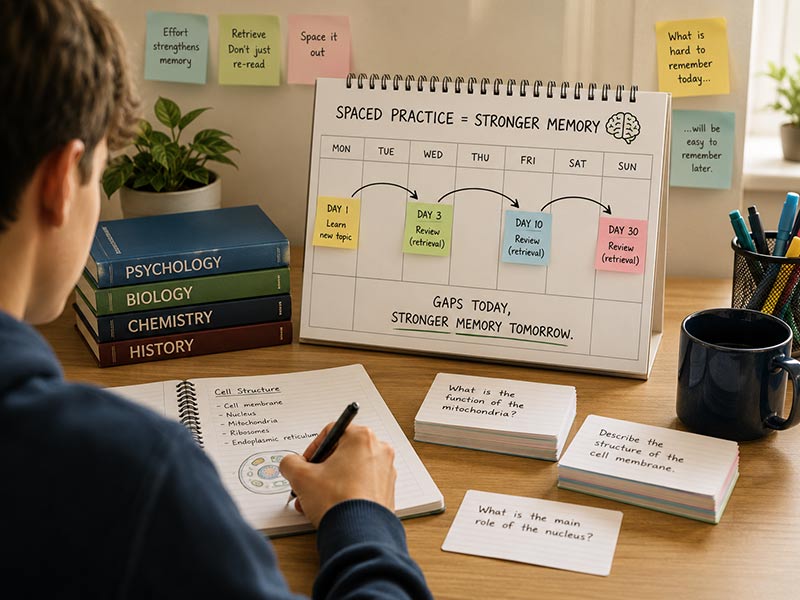
A simple approach might look like this: study a topic, then review it a few days later, then again after a week or two, then again after a month. Each successful retrieval at increasing intervals is a sign that the memory is becoming more stable, and the gap before the next review can grow accordingly. This is the principle behind spaced repetition systems and flashcard apps that automatically schedule reviews based on how well you remembered something last time.
For a student without access to such a system, the same idea can be managed with a simple paper calendar or planner. Noting down when a topic was first studied, then scheduling brief review sessions at expanding intervals rather than leaving all revisiting until the weeks immediately before an exam. The specific intervals matter far less than the underlying habit of returning to material more than once, with genuine gaps in between.
Spacing across a curriculum, not just a revision timetable
Spaced practice is not only useful for individual study. It has
clear implications for how a curriculum is sequenced. Topics that are taught once, tested, and then never deliberately revisited tend to fade from memory well before an end-of-year or end-of-course assessment. Building in planned opportunities to revisit earlier topics, even briefly, keeps them active in a way that a single teaching block cannot achieve on its own.
This is one of the reasons spaced practice sits comfortably alongside the National Metacognition Framework developed by the Institute for Advanced Learning & Metacognition, which encourages schools to think about learning as something that develops over an extended period, rather than being complete once a topic has been taught and tested for the first time.
A strategy that rewards patience
Spaced practice asks for something that can feel uncomfortable in a culture geared towards short-term results: patience. The benefits of spacing are not always obvious in the moment, since forgetting some material before a review session can feel like a step backwards rather than a sign that the next round of practice will be more effective. Understanding the evidence behind why this happens can make it considerably easier to trust the process, rather than reverting to cramming when a deadline feels close.
For schools, colleges and individual learners looking to put this into practice, the shift required is often more about scheduling and planning than about learning any new technique. Spacing takes the study techniques already being used, retrieval practice among them, and simply spreads them out over time in a deliberate way.