
Some learners seem to manage their own studying almost instinctively. They set goals, notice when a strategy is not working, and adjust their approach without needing to be told. Others, given exactly the same material and instruction, struggle to organise their time, judge their own understanding accurately, or recover well from setbacks. The difference between these two patterns is not raw ability. It is largely a set of learnable skills known collectively as self-regulated learning.
What self-regulated learning actually means
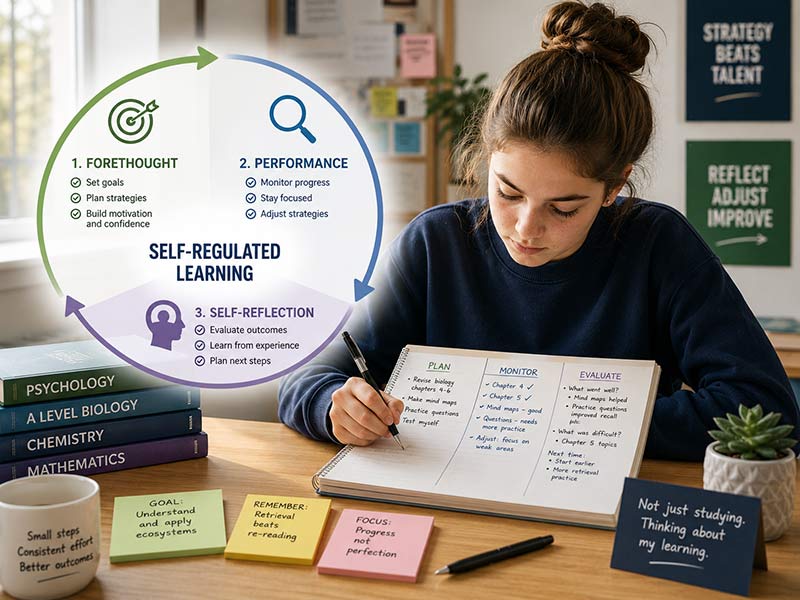
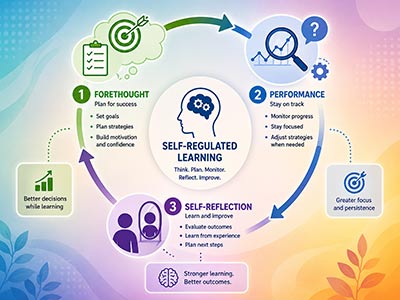
Self-regulated learning, often shortened to SRL, describes the process by which a learner takes an active role in planning, monitoring and evaluating their own learning, rather than simply receiving instruction and hoping it sinks in. The influential model developed by psychologist Barry Zimmerman breaks this into three broad phases:
- Forethought: setting goals, planning an approach, and building the motivation and confidence to begin.
- Performance: monitoring progress while working, staying focused, and adjusting strategy if something is not working.
- Self-reflection: evaluating how the work went once it is finished, and using that judgement to inform what happens next time.
These three phases map closely onto the Planning, Monitoring and Evaluating strands at the heart of the Institute’s own National Metacognition Framework, which is not a coincidence. Self-regulated learning and metacognition are deeply intertwined. You can not regulate a process you are not, at some level, aware of and thinking about.
Why it matters so much
Self-regulated learning is not simply a nice-to-have skill sitting alongside subject knowledge. Research consistently links strong self-regulation to better academic outcomes across subjects and age groups, and the effect tends to be particularly pronounced for learners who face additional barriers, whether that is a challenging home environment, competing demands on their time, or a lack of consistent support with study skills.
This matters because self-regulation, unlike some fixed traits, can genuinely be taught and developed. A learner who has never been shown how to plan a study session, judge their own understanding accurately, or respond constructively to a poor result is not lacking ability; they are lacking a set of strategies that can be explicitly taught, practised and improved over time.
Where self-regulation commonly breaks down
Three points in the process tend to cause the most difficulty for learners who have not developed strong self-regulation:
Judging understanding accurately. Many learners overestimate how well they know material, particularly when relying on the fluency illusion created by re-reading familiar notes rather than genuinely testing their recall. Without an accurate sense of what they do and do not know, planning further study becomes guesswork.
Sustaining effort when a strategy is not working. Effective self-regulation involves noticing when an approach is not producing results and adjusting course. Learners without this skill often persist with an ineffective method simply because it is familiar, or abandon a genuinely effective but harder strategy too early because it does not feel like it is working.
Reflecting constructively after setbacks. A poor test result can be treated as useful information about where to focus next, or as confirmation of a fixed judgement about one’s own ability. The first response supports future improvement; the second tends to undermine motivation and further effort.
Teaching self-regulation in practice
Because self-regulated learning is a skill rather than a trait, it can be built deliberately into everyday teaching, rather than left to develop by chance. Practical approaches include modelling planning aloud before starting a task, building short structured reflection into the end of a lesson or assignment, and explicitly teaching learners how to check their own understanding rather than assuming they already know how.
Crucially, this teaching works best when it happens alongside subject content, rather than as a separate, generic study skills unit disconnected from what students are actually learning day to day. A history teacher modelling how to plan an essay, or a science teacher building in a short retrieval and reflection routine at the end of a topic, is teaching self-regulation in the context where it will actually be used.
A skill worth investing in
For schools and colleges, developing self-regulated learning across a student body is not a quick fix, but the evidence suggests it is one of the more durable investments available, shaping how effectively students learn long after any individual lesson or topic has been forgotten. Unlike a single piece of subject knowledge, a well-developed capacity for self-regulation travels with a learner into further study, employment and everyday life, well beyond the specific curriculum in which it was first built.
It is precisely this kind of practical, evidence-informed approach to learning that the Institute exists to support, helping schools move from good intentions to genuinely embedded practice.